
Technology That Works for Your Business

Different organisations arrive with different constraints. These are the situations we usually start from — and how we approach them.

Explore Our Solutions

Every scenario starts the same way

  1. Understand the current setup and constraints
  2. Design the smallest system that solves the problem
  3. Deliver, document and hand over something operable

Scenarios describe typical starting points and possible approaches, not completed client projects.

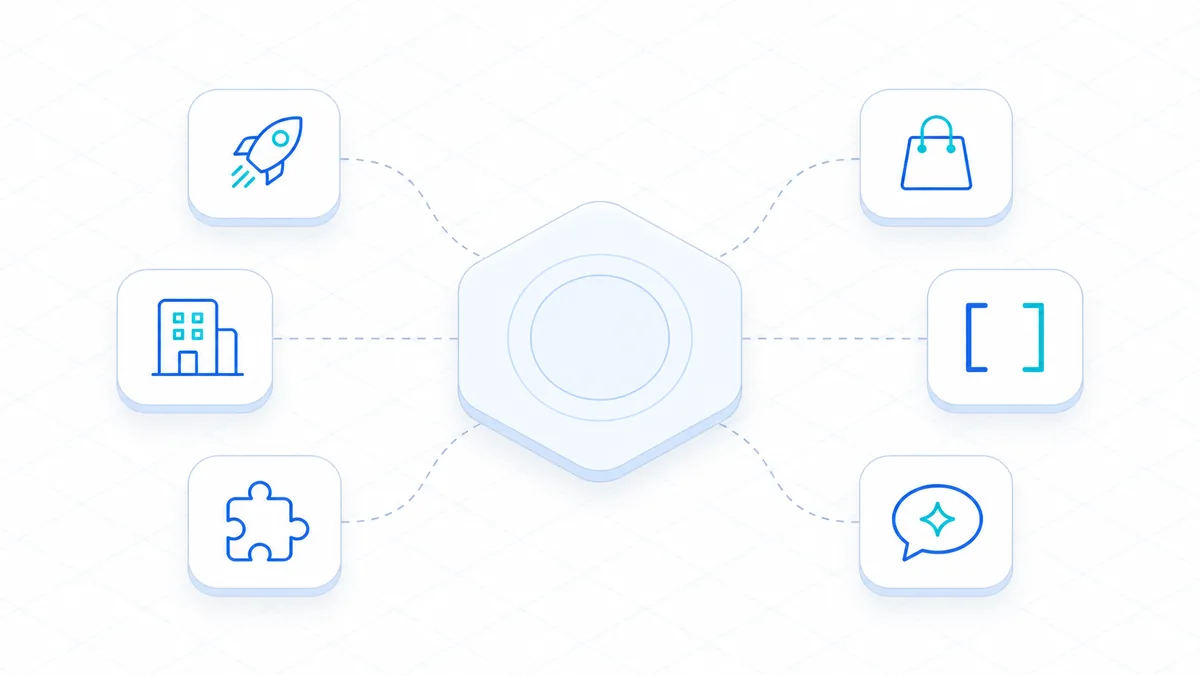
Illustration: six scenario tiles — startup, retail, enterprise, agency, custom infrastructure and AI processes — connected to one central hub.

Startups & SaaS

Launch a product that can carry its first real users.

Web Applications

Typical problems

  • A first version is needed quickly while the data model and access rules are still being decided.
  • Infrastructure, backups and deployment are postponed until they become urgent.
  • Early users immediately ask for roles, integrations and reporting.

Possible approach

  • A short discovery that fixes the core flow, data model and explicit non-goals.
  • A web application built on a stack your team can maintain, with a deployment pipeline from day one.
  • Hosting, backups and monitoring configured before the first external account is created.
  • Releases in small increments so product feedback shapes the roadmap.

Small & Medium Businesses

A credible digital presence without a full IT department.

Website Development

Typical problems

  • The website is outdated or slow, and simple content edits require a developer.
  • Hosting, domains, TLS and backups are split between providers with no clear owner.
  • Inquiries arrive in a mailbox but are never tracked or followed up systematically.

Possible approach

  • A maintainable site with content editing that does not require code changes.
  • Consolidated hosting, TLS, backups and monitoring under one configuration.
  • Forms and inquiries connected to email, CRM or an internal process.
  • Documentation of the setup so the business is not dependent on a single person.

E-commerce

A storefront that stays fast and correct under real traffic.

Website Development

Typical problems

  • Slow mobile pages and a checkout that loses customers before payment.
  • Orders, stock and accounting live in systems that do not talk to each other.
  • Customer and payment data widen the security surface of the whole site.
  • Seasonal campaigns create load the current setup was never sized for.

Possible approach

  • A storefront structured around fast product and category pages.
  • Integrations for stock, orders and accounting instead of manual re-entry.
  • Hosted payment flows, so card data never touches your own servers.
  • Caching, load testing and a rollback path prepared before peak periods.

Enterprise / Internal Applications

Replace fragile spreadsheets and disconnected tools.

Web Applications

Typical problems

  • Critical processes run on spreadsheets and email threads.
  • Several systems hold overlapping data without reliable synchronisation.
  • Permissions and audit trails are unclear or unenforced.
  • A legacy application is hard to extend but too important to switch off.

Possible approach

  • Internal tools with explicit roles, permissions and an auditable data model.
  • APIs and synchronisation between existing systems, with clear ownership of data.
  • A staged migration with a fallback path instead of a single risky cut-over.
  • Documentation and handover so internal teams can operate the result.

Digital Agencies

A technical partner behind your client work.

Web Hosting & Cloud

Typical problems

  • Clients need hosting, maintenance and administration without a full-time hire.
  • Security and infrastructure questions appear inside pitches and questionnaires.
  • Workload peaks when several client projects launch at the same time.

Possible approach

  • Hosting and server administration arranged behind the agency relationship.
  • Separate staging and production environments for client projects.
  • Backups, monitoring and maintenance as an ongoing service.
  • Technical input for proposals and security documentation when agreed.

Custom Infrastructure

Infrastructure shaped around the workload, not a shared plan.

DevOps & Administration

Typical problems

  • The workload does not fit shared hosting or an off-the-shelf plan.
  • Requirements for data location or network isolation cannot be met by the current setup.
  • Running costs and provider lock-in are hard to evaluate.
  • Nobody can see what the servers are actually doing.

Possible approach

  • Infrastructure sized to the workload: managed, VPS, dedicated or cloud.
  • Containerised, reproducible deployments with configuration kept in version control.
  • Private networking, VPN access, firewall rules and least-privilege administration.
  • Monitoring, log aggregation and tested backups from the start.

AI-Enabled Business Processes

Practical AI where it reduces real manual work.

AI Solutions

Typical problems

  • Repetitive document and email handling consumes hours that scale with volume.
  • Knowledge is buried in files, tickets and inboxes that nobody can search reliably.
  • There is pressure to use AI without a defined use case or success measure.
  • Sensitive data rules out sending everything to an external provider by default.

Possible approach

  • One narrow use case with a measurable before-and-after instead of a broad AI programme.
  • Retrieval over internal documents with source references and permission boundaries.
  • A private model or a provider API chosen by data sensitivity and operating constraints.
  • Human review and quality evaluation before anything is used in production.

Let's Build What's Next

Tell us what you need — development, hosting, security or AI. We'll discuss a solution for your goals.

Contact page