
Built Around Requirements, Not Templates
ADKHost works across development, cloud infrastructure, security and AI. This page explains how we approach projects and what we deliberately do not claim.
Four disciplines, one team
- Development
- Cloud infrastructure
- Security
- AI & automation
One team across the whole chain, or exactly the part you need.
Our approach
One System, Not Four Separate Decisions
A product does not become reliable because one layer was bought from a specialist. It becomes reliable when the layers are designed to work together.
Most digital projects do not fail because a single technology choice was wrong. They fail because development, hosting, security and operations were separate decisions made by different people at different times.
We design with deployment, access control and maintenance in mind from the start. That usually means fewer components, explicit ownership and a documented operational path — not more tools.
Not every project needs the whole chain. Engagements begin where the problem is: one website, one application, one migration, one security review. Scope expands only when there is a reason for it.
How decisions are made
- 01
Requirement before technology
The stack follows the workload, team and constraints — not a preference carried from the last project.
- 02
Maintainable over clever
A solution another engineer can understand in a year is worth more than a clever one nobody can operate.
- 03
Security during design
Access rules, secrets handling and backup paths are decided while the system is being shaped.
- 04
Explicit ownership
It stays clear who operates what, which accounts exist and what happens when something fails.
Brand logic
From Discovery to Ongoing Support
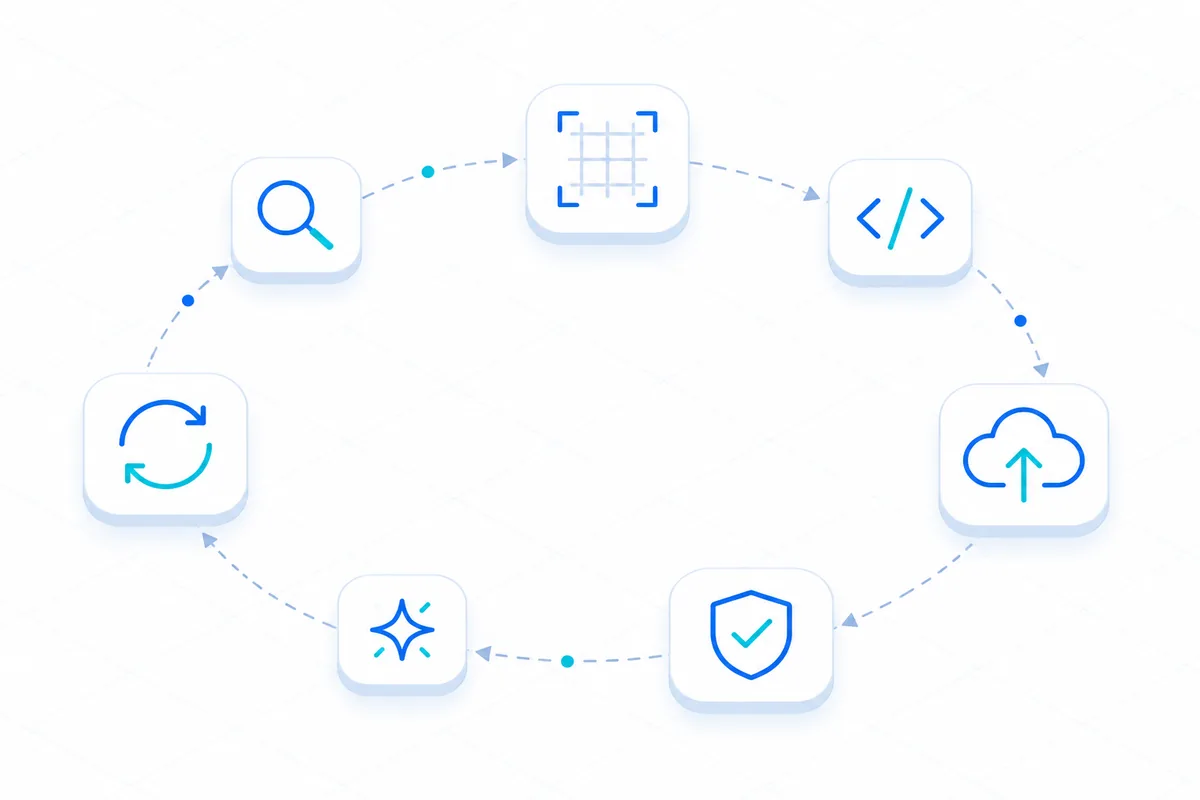
Discover → Design → Develop → Deploy → Secure → Automate → Support. It is one continuous lifecycle, and each stage feeds the next.
A website that later becomes a platform does not restart the process — the same stages repeat with a different scope, and each pass leaves documentation behind.
Discover
Goals, constraints, existing systems and risks are mapped before anything is built.
Design
Architecture, data model, interfaces and the delivery approach are defined.
Develop
Features are built and integrated in reviewable increments.
Deploy
Environments, pipelines and release steps are set up for reproducible deployments.
Secure
Access control, hardening, backups and monitoring are applied to the running system.
Automate
Repetitive operational and business steps are automated where it actually pays off.
Support
Monitoring, maintenance and incremental improvements continue after launch.
Principles
How We Work Together
The same principles apply whether the engagement is a single website or a long-running platform.
- 01
One Technical Partner
Development, infrastructure, security and AI stay under one technical roof, so trade-offs are discussed with the whole system in view.
- 02
Built Around Your Requirements
Architecture follows your constraints, data and workflows — not a template package with your logo on it.
- 03
From Development to Deployment
The same team designs, builds and ships, so the gap between working code and a working production system stays small.
- 04
Security-Aware Engineering
Access rules, backups and hardening are considered while the system is designed, not bolted on after launch.
- 05
Long-Term Evolution
Products are monitored, maintained and extended. The first release is treated as a starting point, not a finish line.
Working together
What Collaboration Looks Like
No fixed packages and no hidden sequences: the process adapts to scope, but the responsibilities are always written down.
A conversation about the situation
We start with what exists, what hurts and what the business needs next. If the request does not fit our work, we say so.
Written scope before code
Deliverables, architecture, dependencies, assumptions and open questions are agreed before implementation starts.
Delivery in visible stages
Work is split into reviewable stages, with a staging environment wherever the project needs one.
Operational handover
Documentation, access management and runbooks are part of delivery, not an afterthought after go-live.
Support that can grow
Maintenance, monitoring and further development are agreed separately, so the relationship matches the actual need.
An honest note
What This Site Does Not Claim
Marketing pages often carry claims that cannot be verified. This one avoids them on purpose.
- No invented clients, case studies or testimonials. Project work is described only where a client has agreed to it.
- No fabricated team members, office photos or company history.
- No certifications, partnership badges or awards that have not actually been obtained.
- No uptime percentages, response-time guarantees or statements that a system is "100% secure".
- No public price list: scope and effort are estimated after requirements are discussed.
If a statement on this site cannot be checked or confirmed, it should not be here. That standard applies to this page as well.
Let's Build What's Next
Tell us what you need — development, hosting, security or AI. We'll discuss a solution for your goals.